YouTube's "inauthentic content" rules: how to keep an AI animated channel monetizable
Short answer: YouTube does not ban AI-made videos. Its Partner Program rules target content that is mass-produced, repetitive or generic, where videos are interchangeable and add nothing for the viewer. An animated channel made with AI can stay eligible when every video has its own script, its own angle and real creative decisions behind it. This is our plain-language reading, not legal advice, and results vary; no income is guaranteed.
Written by the Buy Agent Skills team. Updated 11 November 2026.
What the policy actually says
YouTube's monetization policies say content in the YouTube Partner Program (YPP) should not be "mass-produced, generic, repetitive, or manipulative", and should be made for the enjoyment or education of viewers rather than for the sole purpose of getting views. The examples YouTube gives include:
- similar or repetitive content with low educational value, commentary or narrative, or minimal variation across videos;
- videos where characters are put in the same situation over and over again with the same outcome, that is, one storyline template reused across many videos;
- AI-generated content made with generic or unoriginal templates that gives the impression of mass production without adding the creator's own insight or perspective;
- videos that are interchangeable, where no single one gives the viewer creative, educational or other value.
Read that again for what it leaves out. It says nothing against using AI, an animation tool or a coding agent. The test is the result: would a viewer see the same video ten times with the nouns swapped?
Always read the source: YouTube's YPP policies page. Wording changes, and YouTube decides how it applies to your channel.
Do animated AI videos need an AI label?
Separate question, separate rule. YouTube asks creators to disclose realistic altered or synthetic content, for example making a real person appear to say or do something they did not, or altering footage of a real event or place. Its help page says you do not need to disclose clearly unrealistic content, and gives examples such as an animation inside a fully animated video or a fantastical scene. Realistic content that could be mistaken for real needs the label, and repeatedly failing to disclose can lead to removal of content or suspension from YPP (YouTube's disclosure page).
So a clearly cartoon short usually does not need the label. Two cautions:
- "Animated" is not the same as "cannot mislead". If you depict a real, named person doing or saying something they never did, treat that with extra care and read the disclosure page.
- No label requirement does not mean the inauthentic-content rule is off. They are two different checks.
What tends to get flagged
Going by YouTube's own examples and what creators report in public discussions (third-party, not official), channels run into trouble when they:
- upload dozens of videos built from one template with only the topic changed;
- reuse the same script structure, same jokes, same stock sets and same voice with no new angle;
- publish at a volume no one could review, so nobody has checked facts, titles or thumbnails;
- re-upload or lightly reword other people's content.
Volume alone is not the problem; sameness without value is. A channel posting daily can be fine if each video is its own piece. A channel posting daily from a fill-in-the-blank template is the pattern the policy describes.
The 8-point "is this video original enough" checklist
Run this before every upload. If you cannot answer yes to most of it, hold the video.
- New script. Was this script written for this story, not generated by swapping a topic into last week's script?
- Your angle. Can you state in one sentence what this video says or shows that a viewer will not get from the previous five?
- Facts checked. Is every spoken claim and on-screen number checked against two independent sources? (See the claim-table method.)
- Different sets and framing. Does this video use different locations, camera moves or compositions, not the same shot list recoloured?
- Cast that fits. Are the characters, outfits and expressions chosen for this story rather than defaulted?
- Your voice. Does the narration reflect your own editing choices (pacing, word choices, where the pauses sit), not unreviewed raw output?
- A human approved it. Did a person watch the finished video start to end and fix what was wrong before posting?
- It earns its length. Would a viewer lose something if you deleted it? If not, do not publish it.
Keep a one-line note per video with your answers. If YouTube ever asks about your content, a record of how each video was made is useful.
Where a pipeline helps, and where it does not
A repeatable pipeline is not the same as a template. A pipeline fixes the boring parts, such as rendering, captions and export, and leaves the parts that make a video different (topic, script, facts, cast, sets) as inputs you choose every time.
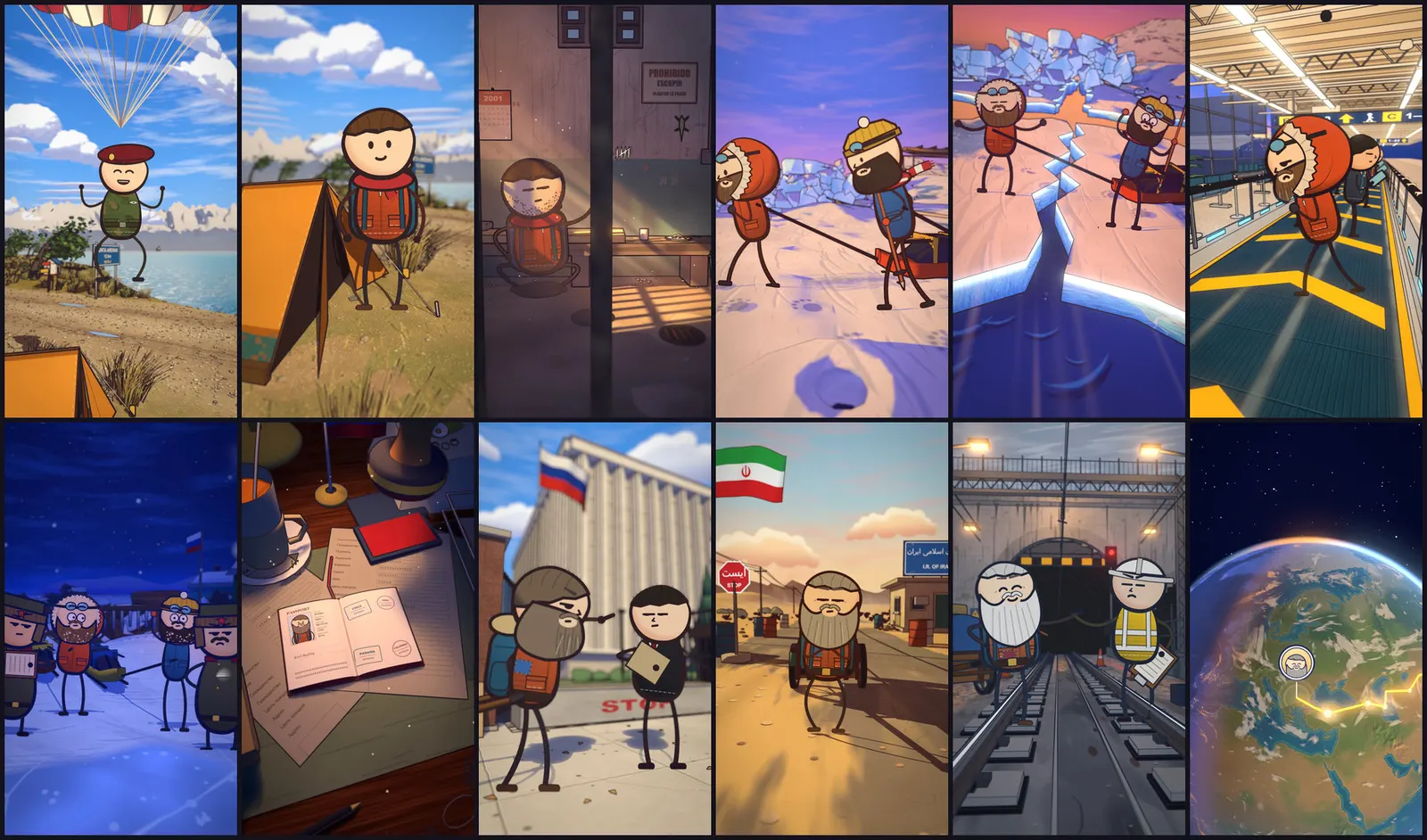
The Cartoon Films pack is built that way. It is a 12-step pipeline for vertical animated short films that works with Claude Code and Codex-style coding agents, though to be plain about testing: it was tested end to end with Claude Code on macOS Apple Silicon, and not on Windows, Linux or in Codex. You need macOS Apple Silicon and Blender to use it. Relevant to this article:
- It runs a claim-table fact check and a separate truth audit before render, which covers point 3 above.
- Scripts, sets, cast and props are chosen per video, which supports points 1, 4 and 5.
- It stops for human review before anything is posted, which covers point 7. (See our scheduled-posting workflow for the gates.)
A real example of the effort involved: our example film is 74.6 seconds, 34 shots, and a full render took about 1 hour 45 minutes on a 16 GB M1 Pro. A tool cannot make a video original for you. It can make doing the work, and recording that you did it, faster.
For topic ideas that suit this approach, see true-story topics for animated short films. For the full workflow, see how to make faceless animated YouTube Shorts with AI.
FAQ
Is AI-generated content demonetized on YouTube? Not automatically. YouTube's policy concerns mass-produced, repetitive or generic content. AI use on its own is not named as a violation.
Do I need to label an animated video as AI-generated? YouTube's disclosure rule is aimed at realistic altered or synthetic content. Clearly unrealistic or animated content generally does not need it, per YouTube's help page. Check the current page, and take care with real people.
How many videos can I post per day? YouTube does not publish a safe number. The checklist above is a better guide than a quota.
Will following your checklist guarantee monetization? No. YouTube makes the decision. The checklist helps you make videos that are individually worth watching, which is what the policy asks for.
Can I make money from an animated channel at all? It can be possible, but it is not guaranteed and depends on many things. See what's realistic with animated short films.
Next step
Copy the 8-point checklist above into your upload routine. If you want a tested pipeline that keeps the fact check, the per-video choices and the human review built in, see the Cartoon Films pack (macOS Apple Silicon and Blender required).
Results vary; no income is guaranteed. This article is general information, not legal or financial advice.